Essential cookies keep the site running. With your OK we also use optional ones to understand how the site is used and make it better. See our Cookie Policy.
Your choice is kept for 12 months.
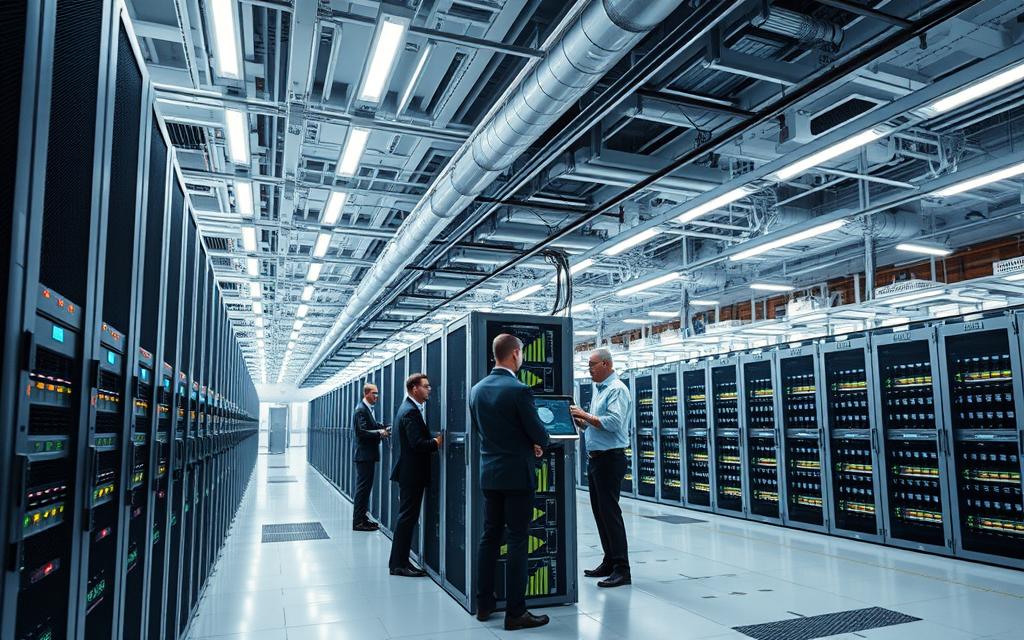
The modern digital economy depends a lot on the hyperscale data center. These huge places are key for the services we use daily. Without them, the internet would stop working.
In the United States, businesses are growing fast in the cloud expansion. This growth is great but also brings big challenges. Companies face tough issues like saving energy and keeping hardware in good shape.
It’s important for companies to understand these challenges to stay ahead. By designing these spaces well, businesses can make sure their services are reliable for a long time. This article looks at the technical hurdles of high-capacity computing.
The hyperscale data center is at the core of the internet. It’s a modern engineering wonder. These centers are key to handling the vast amounts of data processed every second worldwide. They make it possible for us to enjoy fast and reliable digital experiences.
A hyperscale data center can grow to meet huge demands. Unlike old data centers, these are massive, covering hundreds of thousands of square feet. They house tens of thousands of servers, built for efficiency and quick setup.
What makes these centers special includes:
The growth of cloud computing services makes these centers crucial. Today, businesses use the cloud to grow quickly. They need data center solutions that can handle sudden spikes in traffic without slowing down.
“The transition to hyperscale architecture is not merely a trend; it is a fundamental requirement for any organization aiming to compete in a global, data-driven market.”
These centers centralize resources, making cloud computing services reliable. They keep applications running smoothly, no matter where users are.
The market for data center solutions is booming. As more businesses use AI and machine learning, they need faster computing. This drives the need for bigger, more efficient data centers.
Experts say the hyperscale data center does more than just store data. It sets the bar for energy efficiency and innovation in tech. As they evolve, they will keep leading the digital transformation worldwide.
The growth of digital services depends on designing facilities that can grow easily. Engineers need to go beyond old layouts to meet today’s cloud service needs. They must combine physical space, power, and cooling into one system.
Large scale infrastructure needs to be flexible and use standard parts. Open-floor plans help move or upgrade hardware without limits. This lets new server racks be added quickly when needed.
Having the same design everywhere is key for success. It makes maintenance faster. This standardization cuts down on mistakes and keeps things running smoothly.

Today’s enterprise data management must balance performance and the environment. Designers focus on Power Usage Effectiveness (PUE) to cut waste. New cooling methods, like liquid immersion, are now common.
“Sustainability is no longer an optional feature; it is the core requirement for the next generation of digital infrastructure.”
Using renewable energy is also crucial. Power from wind or solar farms lowers carbon emissions. This green choice meets social responsibility goals and keeps operations efficient.
Modular design is key for scalable data storage. Instead of huge, fixed structures, companies use pre-made modules. This makes adding new capacity faster.
Good IT infrastructure management uses these modules for growth. Each module works alone, so upgrades don’t affect the whole facility. This agility is vital for businesses that must quickly respond to market changes.
Modern data centers face big challenges due to their size. They need to balance performance, cost, and physical limits. Keeping these huge systems running smoothly is a big task.
Managing power and cooling is a big challenge. Engineers use advanced cloud technology to watch energy use in real-time. This helps avoid waste and cut costs.
Automated systems help distribute tasks smartly. This prevents any one server from slowing things down. It’s key for keeping up with the fast pace of digital services.
Keeping data safe in a big facility needs a strong defense. Data center solutions must combine physical and digital security. Meeting global standards is a must.
“Reliability is not just about uptime; it is about the integrity of the entire ecosystem and the trust placed in it by the end user.”
Regular checks and automated threat detection are key. They help find and fix problems before they happen. IT teams must always stay ahead of new threats.
Keeping services running smoothly is the main goal. Scalable data storage makes sure data is always available. Redundancy in the system prevents failures.
Good IT infrastructure management means planning ahead. Teams can replace old parts before they fail. Here’s what’s important for keeping things stable.
| Operational Area | Primary Goal | Key Strategy |
|---|---|---|
| Resource Allocation | Efficiency | Automated Load Balancing |
| Security | Compliance | Multi-layered Encryption |
| Reliability | Uptime | Predictive Maintenance |
The digital world is changing fast as more data needs to be processed. Big names like Amazon Web Services and Microsoft Azure are leading the way. They’re making systems smarter and more reliable.
Artificial intelligence and machine learning are now key in managing data centers. They help control cooling and power better. This makes sure systems work well even when they’re under a lot of stress.
Where data centers are built matters a lot. Places like Southeast Asia and Latin America are seeing more growth. This helps keep data fast and reliable for everyone worldwide.
In the next ten years, companies will focus on being green and fast. They’ll keep using cloud services to stay ahead. It’s important to watch these changes and make sure your digital plans are up to date.
Following the industry, hunting a role or hiring for one: one account opens all of it.
Enter your email or username and we'll send you a secure link to set a new password.
Discussion