Essential cookies keep the site running. With your OK we also use optional ones to understand how the site is used and make it better. See our Cookie Policy.
Your choice is kept for 12 months.
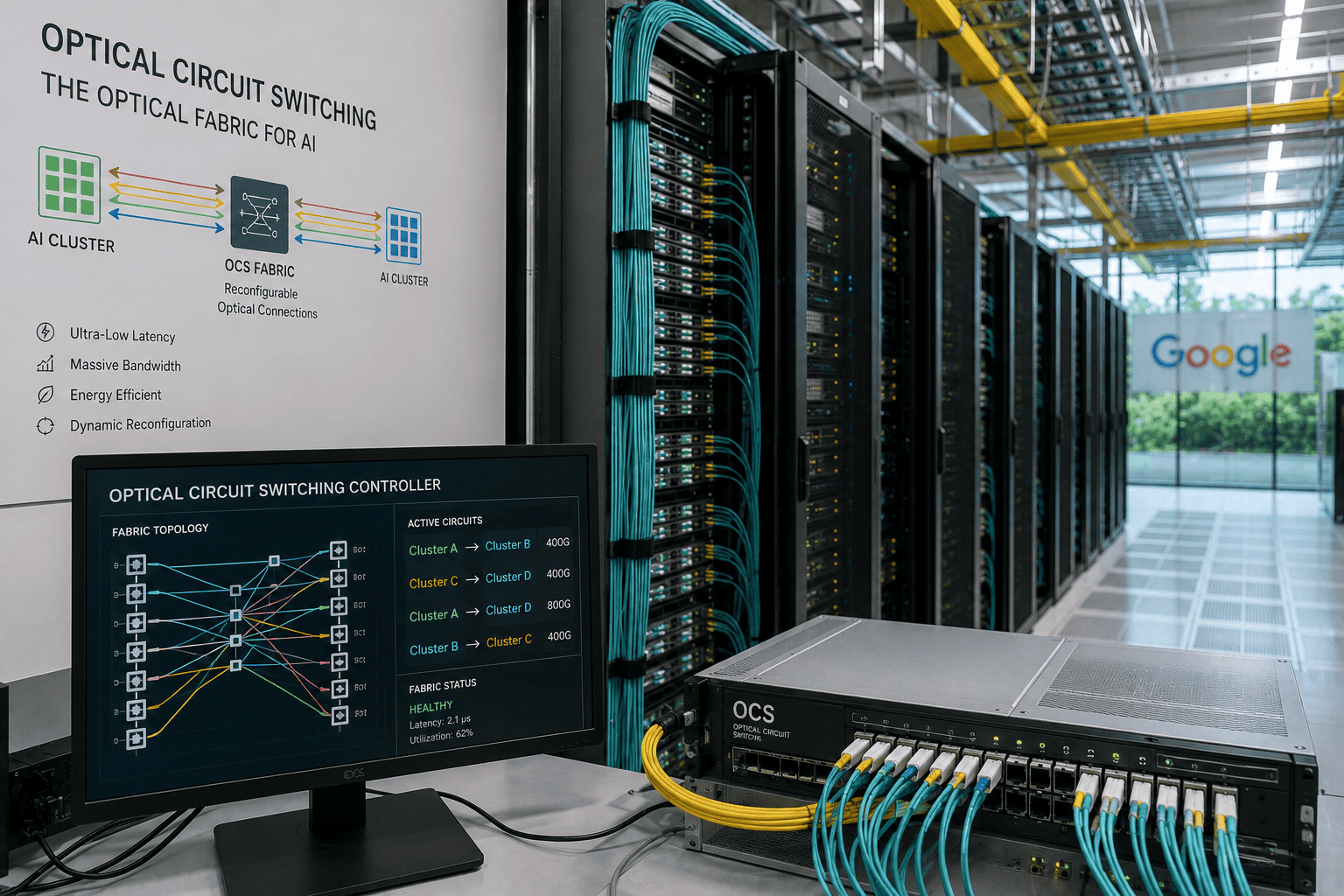
Google is leading a big change in data centers. They’re moving away from old electrical switches. Instead, they’re using optical circuit switching for huge workloads. This change is key for the future of big computing.
This new tech is the heart of AI & HPC tasks, offering better bandwidth. It’s a step up from old methods that can’t keep up with today’s data. By updating their Digital Infrastructure, they keep Networking fast and reliable. This is crucial for companies that need to process info quickly.
At the heart of today’s advanced AI fabrics is a new way to route data with light. This method, called optical circuit switching, is changing the game for networking. It goes beyond the old ways of doing things.
Optical circuit switching uses tiny mirrors to guide light between ports. It doesn’t need to change light into electrical signals and back.
This keeps the signal in its optical form, making it very efficient. The tech has some key features:
In high-performance networking, speed is everything. Optical circuit switching lets data move fast, thanks to the speed of light.
Old electronic switches have delays because of signal conversion. Optical circuit switching cuts out these delays, making it fast for AI workloads.
This change helps data centers grow. As AI gets more complex, fast data routing is key for any top-notch system.
At the heart of every AI breakthrough is a strong digital infrastructure. This complex system is the base for today’s computing tasks. It lets machines quickly process huge amounts of data.
In today’s tech world, this term covers many parts. It includes fast processors, memory, and data management algorithms. All these work together to support high-level computing.
Without a solid digital infrastructure, computers can’t do much. The hardware stays still, and software can’t run complex tasks.
Creating advanced AI models needs thousands of processors working together. This is only possible with systems designed for extreme scalability and efficiency.
There’s a close link between hardware and software in AI. As software gets more complex, hardware must improve to keep up.
The fast growth of AI & HPC wouldn’t happen without a scalable base. Investing in better networking and processing ensures systems can tackle future challenges.
Google has changed the game in cloud computing by making its own hardware. They don’t use standard parts like everyone else. This lets them control their network in ways others can’t.
Google’s network grew because they needed it to be huge and fast. They added special optical parts to their servers. This makes their network work better for AI tasks.
Google has made big steps in making their systems more efficient. They’ve improved how their systems handle heat and power. This is a big deal for keeping things running smoothly.
These new ideas set a high standard for the cloud computing world. Other companies are watching to learn how to do the same. Google’s focus on data center networking is leading the way for digital infrastructure worldwide.
Artificial intelligence is now key for innovation in data-heavy computing. Traditional methods can’t keep up with the vast amounts of data from modern apps.
This change means systems need to handle data differently. By adding intelligent software layers, developers can better use resources and boost system efficiency.
Machine Learning algorithms are changing what’s possible in computing. They help systems predict data patterns and improve workflows in real-time. This reduces bottlenecks in processing.
The industry is moving toward specialized hardware accelerators. These work with fast networking to move data quickly. This combo is key for high throughput in big data centers.
The future focuses on AI in edge devices and the Internet of Things (IoT). More processing near data sources means a need for agile and responsive networking.
Future AI will likely be more decentralized, with devices making decisions on their own. This shift in Machine Learning and Internet of Things (IoT) needs a flexible infrastructure. It must handle unpredictable traffic well. The network’s ability to support fast data exchange is crucial for success.
High-Performance Computing is key for scientific breakthroughs and data analysis today. It combines huge computing power to solve problems that regular computers can’t. This field, known as AI & HPC, boosts innovation in fields like climate modeling and drug discovery.
High-Performance Computing focuses on speed and scale. It links thousands of processors to do trillions of calculations per second. This power lets researchers simulate complex phenomena or train big machine learning models accurately.
These systems are vital for fast insights from big datasets. Without them, many research projects would be too slow. Their efficiency is shown by how well they handle lots of data quickly.
Despite their power, HPC systems face big challenges. Power consumption is a big worry, as running thousands of nodes uses a lot of energy. Also, thermal management is key to avoid hardware failure and keep systems stable.
Data bottlenecks are another big problem in AI & HPC. Traditional electrical connections can’t handle the huge data flow between processors. As data needs grow, these connections cause delays that slow down performance.
Electrical signals lose quality over distance and get hot, making them outdated. This is why moving to light-based communication is the next step. It will help overcome current limits and boost efficiency.
As AI workloads grow, the move toward optical circuit switching is key for efficient data center networking. This tech uses light paths instead of electrical signals, boosting data throughput. It also cuts down on latency by avoiding frequent electrical-to-optical conversions.
This tech cuts power use by a lot. Optical switches don’t need complex electrical buffers, making them more energy-efficient. This is a big plus for large AI clusters that use a lot of power.
Also, optical solutions pack more ports in the same space. This lets engineers grow their systems without needing bigger facilities. Moving to optical solutions also helps meet higher bandwidth needs and simplifies networking setups.
Electrical packet switching has been good, but it has limits like heat and signal loss. It can’t handle high speeds well because it has to process every packet. Optical circuit switching, on the other hand, offers a direct path for data, making it more cost-effective at scale.
The table below shows the main differences between these two methods in data center networking:
| Feature | Electrical Packet Switching | Optical Circuit Switching |
|---|---|---|
| Power Consumption | High (per port) | Low (passive switching) |
| Latency | Variable (buffering delays) | Ultra-low (near speed of light) |
| Scalability | Limited by heat/power | High (dense fiber arrays) |
| Cost at Scale | Increases linearly | Decreases per unit |
While starting with optical fabrics is complex, the long-term benefits are clear. Companies that use these advanced systems get ahead by saving on operations. This change opens a new chapter for high-performance computing.
Scaling AI clusters means moving away from old, manual cabling. As data centers expand, copper and fiber connections become bottlenecks. Modern setups must handle these challenges to keep performance high.
The growth of Cloud Computing has changed how workloads change fast. AI and high-performance computing need huge amounts of bandwidth quickly. When hardware doesn’t change, it’s hard to use resources well during busy times.
Static networks often mean unused hardware and wasted energy. They can’t adjust to changing traffic patterns easily. True scalability means a network that grows with the software it supports.
Optical circuit switching makes networks flexible. It lets engineers change connections with software commands. This is key for handling Cloud Computing demands.
With Virtualization, the physical and logical networks can be separated. This makes it easier to use resources where they’re needed. Optical fabrics help scale AI clusters smoothly as needs change.
Switching to these advanced solutions cuts down on work. Now, new setups can be done in seconds, not days. This dynamic reconfiguration keeps infrastructure supporting growth, not holding it back.
Many organizations look to Google’s data center successes for inspiration. They adopt optical circuit switching to boost efficiency. This is key for handling the big needs of Machine Learning today.
Google has made optical circuit switching work in its data centers. This move cuts down latency and boosts overall speed. Performance gains are big when training large models that need fast data movement.
These data centers can change network paths on the fly. This lets them handle changing traffic without manual help. So, Machine Learning tasks get the bandwidth they need, keeping the system fast even when it’s busy.
Starting early with next-gen AI fabrics had its challenges. Engineers faced tough issues with software and hardware at first. They learned that a robust monitoring system is key to spotting problems early.
It’s important to test new networking setups in small, controlled ways. This helps teams improve their plans and avoid downtime. By always trying to get better, companies can grow their Machine Learning work while keeping things running smoothly.
Looking ahead, high-performance computing is set for a big change. The need for handling more data means we must rethink how devices talk to each other. Networking is now a key area for growth and innovation in AI & HPC.
The next decade will see silicon photonics become the norm for data centers. This technology combines optical and silicon components to boost bandwidth and cut power use. It brings light-based communication closer to the processor.
This change will remove old electrical limits on data speed. As these techs improve, they’ll work with current optical systems. This will make data centers more efficient for big machine learning tasks.
AI infrastructure will become more autonomous and self-optimizing in the future. It will use smart analytics to adjust network paths quickly. This means data will move faster, without needing humans to help.
These new techs will shape the future of computing. Companies that adopt these fast, flexible systems will stay ahead. Below is a table showing how things will change.
| Technology Feature | Current Standard | Future Evolution |
|---|---|---|
| Interconnect Type | Electrical Copper | Silicon Photonics |
| Optimization | Manual Configuration | Autonomous AI Control |
| Energy Efficiency | Moderate | Ultra-High Efficiency |
| Latency Levels | Microseconds | Nanoseconds |
The move to software-defined environments brings new security challenges. As we leave behind static hardware, managing digital infrastructure gets much harder. We must stay ahead to ensure our systems stay safe and perform well.

With virtualization, the attack surface grows in ways we didn’t expect. Old defenses can’t keep up with the fast, software-defined paths data takes. If one part of the system is breached, the whole thing could be at risk.
Also, using automated tools for management opens up new risks. Mistakes in virtualization can let threats move quickly across the network. Finding these weaknesses early is key to keeping our systems safe.
Organizations need to adopt a zero-trust networking model. This means not trusting anyone, inside or outside the network, by default. By checking every request, we can lower the damage from breaches in our digital infrastructure.
Adding hardware-level encryption is also crucial. It keeps data safe even if software layers are attacked. Security should be built into projects from the start to keep them safe and running smoothly.
| Security Feature | Traditional Approach | Modern Strategy |
|---|---|---|
| Perimeter Defense | Firewall-centric | Zero-Trust Model |
| Data Protection | Software Encryption | Hardware-level Encryption |
| Infrastructure Control | Manual Configuration | Automated Policy Enforcement |
| Threat Detection | Reactive Monitoring | Proactive AI Analytics |
Modern data centers face a big challenge as they try to meet the huge needs of artificial intelligence. Google is leading the way by focusing on optical circuit switching for complex tasks. This change is a big shift in how information moves across the world.
The move to optical fabrics gives the needed bandwidth for High-Performance Computing at a large scale. These systems use less energy but move more data. This is key as the Internet of Things (IoT) grows, adding more connected devices.
Industry leaders need to adopt these changes to stay ahead in a data-driven world. Investing in optical tech helps keep up with fast changes in machine learning. This progress is crucial for the next level of digital services and global connections.
Following the industry, hunting a role or hiring for one: one account opens all of it.
Enter your email or username and we'll send you a secure link to set a new password.

Discussion